
Preparing for Court
How social media posts get used against parents in custody cases
Learn how posts, photos and messages get used in custody cases, why deleting can backfire, and how to protect your child while the case is open.
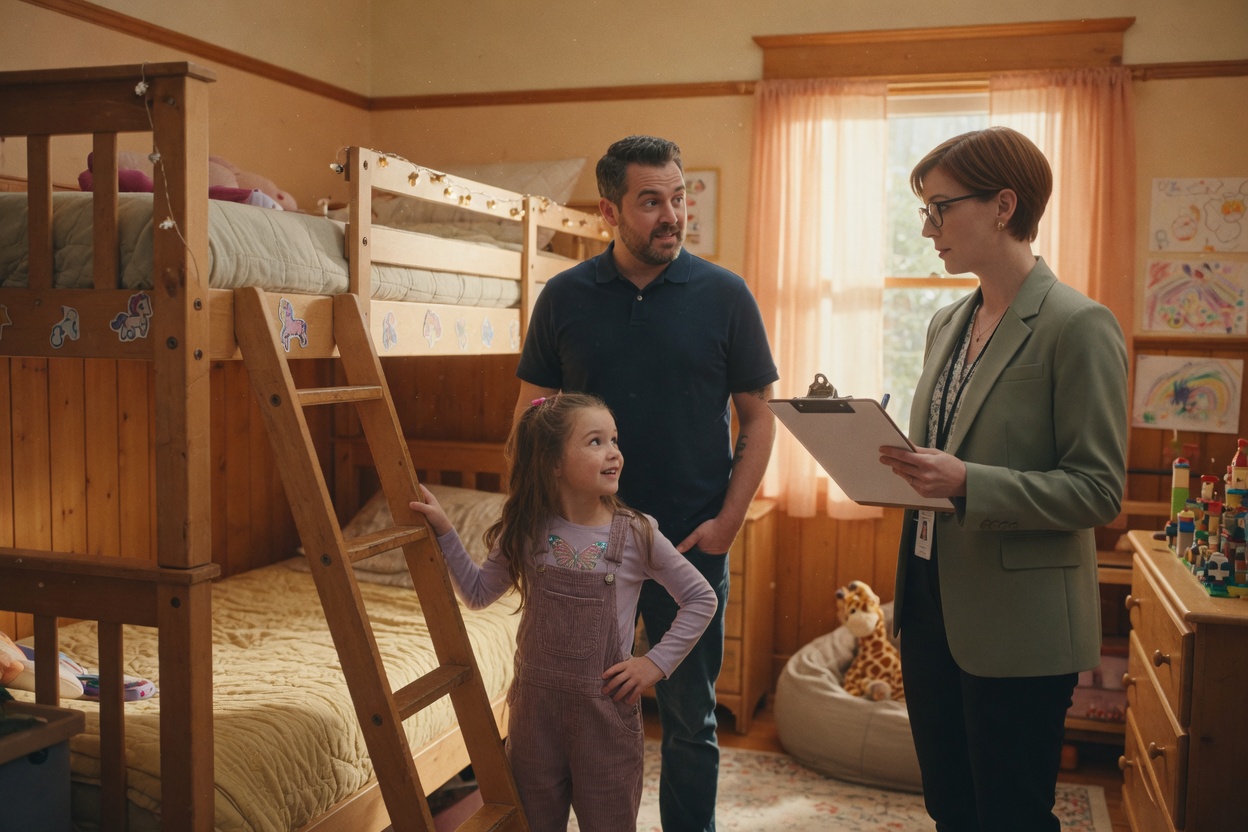
Learn what a custody evaluator may check in your home, which safety items have real legal rules, and how to prepare honestly for a home visit.
Best for the Children Editorial·10 min read·August 28, 2025·Updated October 13, 2026
You read the line in the court paperwork, or your lawyer mentions it on the phone: someone may come to see your home. Suddenly you notice the overflowing laundry basket and the gun in the closet. Here is the short answer. No national checklist exists. An evaluator decides whether your home is a safe place for your child that meets the child's basic needs. The items with real rules behind them are firearms, pools, and bunk beds. Everything else comes down to the evaluator's judgment. A visit may not happen at all.
Every custody decision in the U.S. rests on one legal test. According to the Child Welfare Information Gateway, every state, the District of Columbia, and the inhabited U.S. territories require that a child's best interests be considered in custody, placement, and other major decisions. The Gateway names several factors states use, including "parental capacity to provide adequate care," "sibling and other family relationships," and "the child's wishes."
What that list leaves out also matters. The Gateway's summary does not list home cleanliness, a stocked fridge, or pet hair as legal factors. Not every state spells out specific factors in its statute. Some of the rules sit in agency regulations, case law, or local court practice. So any home checklist, including this one, reflects common practice and safety guidance. It is not a list a judge must tick through. The single most useful thing you can do is look up your own state's best-interests statute.
The old assumption is that Child Protective Services inspects both parents' homes in every custody fight. That is not how it usually works. Depending on the state and the case, the person at your door could be any of these:
Child protective agencies such as CPS or a state DCFS are government child-welfare agencies. CASA is a separate volunteer program. CPS mainly investigates abuse and neglect, so in a typical custody case between two fit parents, you are more likely to meet an evaluator than a CPS caseworker.
California also separates its evaluation types. A §3111 evaluation is the standard kind. A §3118 evaluation applies when there is a serious allegation of child sexual abuse. An Evidence Code §730 evaluation is a third category. Ask which kind your case involves, because the rules differ.
Finally, a visit is not guaranteed. Lane County, Oregon, described its evaluations as using "joint and individual interviews, parent-child and home observations, child interviews." It also said plainly: "A home visit is not always necessary." (The county has since said it is "not providing this service at this time," so treat it as an example of how one court operated.)
The home visit feeds a report, and the rules for that report vary.
The fee can be real money too. Lane County charged $1,500, split between the parents. It required its evaluators to hold at least a master's degree in a related field, plus training in custody evaluation, mediation, and domestic violence.
If an evaluator walks through your home, the hazards that matter most are also the ones with published standards. Fix these first.
Guns are the clearest legal issue in many states. As of KFF's data updated January 14, 2026 (drawn from Everytown's gun law database), 26 states have child access prevention laws and 24 do not. Those laws vary a lot:
Most set the age cutoff at under 18. Counts differ by source and method. Johns Hopkins counted 27 states plus DC in January 2025. Learn which rule your state follows. Whatever the law says, a locked, unloaded, out-of-reach firearm is easier to explain than one in a nightstand drawer. That last point is a judgment, not a statute.
If you have a pool, the federal Consumer Product Safety Commission's Publication 362 lays out barrier guidelines:
These guidelines are voluntary, but many states and localities write them into building codes. The design of the fence matters as much as its height. A Cochrane review found that four-sided "isolation" fencing, which separates the pool from the house as well as the yard, sharply cut drowning odds compared with three-sided fencing (odds ratio 0.17). The review recommends secure, self-latching gates. If your house wall forms one side of the pool enclosure, you have a three-sided setup.
No federal guidance covers ponds or other water on your property. In my opinion, it makes sense to apply the same thinking: a barrier the child can't climb, and a gate that latches itself.
Evaluators generally want to see where your child sleeps. Bunk beds have a voluntary standard, ASTM F1427. It calls for guardrails on both sides of the upper bunk, with no more than 15 inches left open at each end for climbing in and out. It also limits openings so a child cannot get trapped. Under the 1996 version of the standard, openings around the upper bunk must block a tapered test block about 3.5 by 6.2 inches. Openings within 9 inches above the lower mattress must either block that block or let a 9-inch sphere pass through. Those figures come from an older edition, so check the current ASTM F1427 and CPSC rules if your bed is older or homemade. Even so, a top bunk missing a guardrail is an easy thing to spot and an easy thing to fix.
Beyond those items, evaluators use their own discretion, guided by the best-interests standard's focus on a parent's ability to provide adequate care. The items below are common practice and reasonable preparation. None is a statutory requirement, and none decides a case on its own, because a judge weighs every factor together.
In my view, the best preparation is honest repair, not a performance. Lock up firearms the way your state requires, or more securely. Check your pool barrier against the CPSC numbers. Put the guardrail back on the top bunk. Clear the obvious hazards. Then live in the house normally. Evaluators are trained to notice a home that has been staged.
Before the visit, ask your lawyer or the court three questions. What type of evaluation is this? Will the report be confidential? Does your state allow you to respond to it or bring in your own expert? Then read your state's best-interests statute. That statute, not any online checklist, is what the judge will apply.
Learn how posts, photos and messages get used in custody cases, why deleting can backfire, and how to protect your child while the case is open.
Disagree with a Guardian ad Litem report? Learn how to respond with evidence, question the GAL where allowed, and what the judge decides.
Learn how a 50/50 custody presumption changes the court's starting point, who must rebut it, and why your child's best interests still decide.