
Living with the Order
When One Home Allows Social Media and the Other Doesn't
Learn who decides on social media when co-parents disagree, what your custody order and state law may say, and how to set one plan for both homes.
The first week under a new custody order: how to turn the paper into a week your child can see, what to tell them, and the systems to build now.
Best for the Children Editorial·5 min read·September 27, 2026
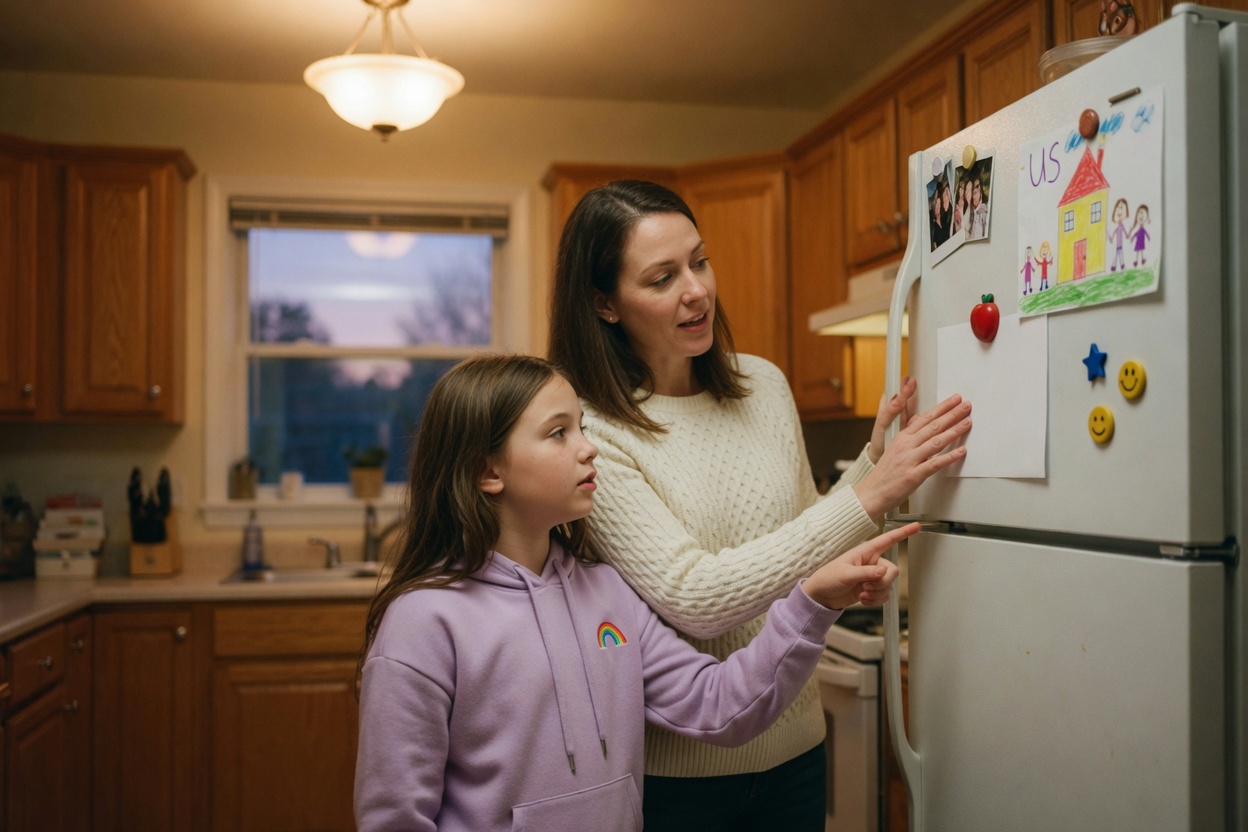
The order is on the fridge. It is longer than a takeout menu and less clear than a school newsletter. The child does not care that you “won” a clause. They care who is picking them up on Wednesday and whether their bed is still their bed. The first week under a new custody order is when the paper either becomes a home or becomes a fight you reenact at breakfast.
Sit down with a blank calendar. Write wake-up house, after-school house, overnight house, and the next three handoffs in times a ten-year-old could read. If you cannot do that from the order, the order is not living in your house yet. Fix the translation before you argue about who is “in contempt of tone.”
Put the calendar where the child can see it without asking permission. Mystery is not safety. A child who does not know which house is Tuesday will fill the gap with worry.
Short, concrete, no verdict. “There is a new plan. You will be here Monday through Wednesday. You will be at the other house Thursday and Friday. School does not change.” Do not add “the judge finally saw the truth.” They did not ask for a winner. They asked where their toothbrush lives.
If they ask why, you can say the adults and the court wrote a schedule so they are not stuck guessing. That is enough. Talking with kids about two homes is the tone. A press conference is not.
The first seven days are when some parents withhold clothes, “forget” the charger, or schedule a haircut in the other parent’s window because they can. The child notices. They do not need a lecture on rights. They need a backpack that has what both houses require.
If the other parent misses an exchange, document it after the child is in bed. During the miss, solve for the child: who is feeding them, who is taking them to school. Whether police will enforce a custody order is a later question. Tuesday morning math is the current one.
Sleep may be ugly. They may ask to call the other home at odd hours. They may be angelic in one house and furious in the other. That is a nervous system catching up, not a closing argument. Hold the schedule unless safety says otherwise. A child who watches the new order collapse in week one learns that paper is theater.
If they refuse an exchange, slow down and look at fear versus stall. When a child refuses to go is a child problem first. Using the refusal to reopen the whole case in week one is how you spend the year in the same parking lot.
Pick one channel for adult talk: a parenting app, email, a shared calendar. Not the child’s phone. Not a sibling. Put school contacts, the pediatrician, and extra-curriculars in both homes this week, not “after things calm down.” Things calm down because you did this.
If a line in the order is unworkable — a pickup that collides with a job you cannot change, a holiday that was written for a different city — do not freelance a new plan and hope. Write the problem down and use the modification path when it is real. When you can change a parenting plan is for a pattern, not for a grouchy Thursday.
Follow it. Then still be a parent: dinner, homework, the joke they like, a bedtime that does not include a recap of court. A perfect clause with a cold house is not what the child asked the adults to win. A slightly awkward first week with two predictable doors is.
If the order is temporary, treat it as real anyway. Temporary is still the child’s Tuesday. Do not tell them “this doesn’t count yet.” They cannot live in a footnote. If it is a final order, do not freeze in fear of the next motion. Live it until a court actually changes it. Most orders do not fade on their own; see whether custody orders expire before you assume the fridge paper has a secret end date.
This is educational information, not legal advice. Your order controls. Read it. If a line is confusing, ask a licensed attorney where you live before you improvise. This page is about the child’s week, not about relitigating the hearing in the kitchen.
This site is not a law firm and this is not legal advice. The first week is when you decide whether the child lives under an order or under a grudge. Put the paper on the fridge. Then cook. Then show up where the calendar says you will be.
Learn who decides on social media when co-parents disagree, what your custody order and state law may say, and how to set one plan for both homes.
A new partner has no automatic say over your court-ordered schedule. Learn who is responsible and how to keep a record that protects your child.
Learn whether your custody order allows an out-of-state Thanksgiving trip, which automatic orders might restrict travel, and how to plan it safely.