Mediation & Settling Outside Court
Should Your Child Sit In on Mediation?
Should your child sit in on custody mediation? Why the room is built for adults, how a child's voice can be heard safely, and what to tell them afterward.

Custody mediation can be free through the court, sliding-scale, or $100 to $500 an hour privately. Learn what drives the cost and what you get.
Best for the Children Editorial·9 min read·June 23, 2026·Updated October 27, 2026
You and your co-parent have just agreed to try mediation instead of fighting it out in front of a judge, and now you're both wondering what this will cost. Court custody mediation is free in some places, including North Carolina and Los Angeles County. Elsewhere, court programs charge anywhere from about $90 per parent to $600 per session. Private mediators often charge $150 to $400 an hour, or sell packages around $400 to $550 per parent. Your actual bill depends on who runs the program, how fees are split, and what's included.
Before you call a private mediator, find out what your local family court offers. Court-connected mediation is often the cheapest route, but prices and rules vary a lot by county.
Free programs. North Carolina courts provide custody mediation at no charge, but only if you have a custody case on file. The process starts with an orientation, followed by a session of up to two hours. The mediator can schedule another session if both parents agree. Los Angeles County's Family Court Services also mediates custody for free and will draft your custody and visitation plan if you reach agreement.
Low-fee programs. Other courts charge modest fees:
Court-appointed doesn't always mean cheap. In Frederick County, Maryland, court-appointed outside family mediators charge $600 per two-hour session. The cost is normally split evenly, though the referral order can divide it differently based on income.
If your court has no program, you earn too much to qualify, or you want more time, you'll pay a private mediator. These are prices some providers publish:
Be careful with national averages you see online. DivorceNet's widely quoted $3,000 to $8,000 estimate is for full divorce mediation, including property and money. It doesn't measure custody-only cases, which are often narrower.
Two mediators with the same advertised rate can produce very different bills. Look for these four things.
Who the rate applies to. "$200 an hour" might be the mediator's total fee or each parent's share. Raleigh's $400 is a total, so each parent pays $200. Common Ground and FairField quote overtime per person, which doubles the real hourly cost.
Minimum bookings. Arnold Law and Mediation charges represented clients a flat $600 for up to four hours. Finishing early doesn't lower the price.
Drafting. An agreement that isn't written down is hard to file. FairField includes documentation and revisions in its package. Community Solutions bills drafting at its hourly rate.
What happens after the first session. Chester County's $90 court session covers only two hours. If you need more time, you switch to the mediator's private hourly rate. That rate must be disclosed in advance and written into a mediation agreement.
The mediator's fee is rarely the only expense. Others to plan for:
Here's what the published rates add up to for a couple splitting costs evenly. Lawyer and filing fees aren't included.
Mediation saves money when it works. When it doesn't, you've paid for mediation and still have a court case ahead of you. In Florida's Twelfth Circuit, if parents don't reach agreement, the mediator reports that the court needs to decide. Parents can also choose to try another session.
Sometimes the result is partial. You might settle the holiday schedule and leave school choice to the judge, which can shorten the court fight that follows. Parents on online forums describe both outcomes. On a men's divorce forum, one father questioned a $9,000 California quote for five meetings including filing. Another commenter said he spent $5,000 on custody mediation that never settled. These are individual stories, not typical prices, but they show why it pays to ask how long a mediator expects your case to take.
A low price doesn't make mediation appropriate for every family. The National Council of Juvenile and Family Court Judges generally advises against mediation when domestic violence, stalking, coercion or sexual assault create safety concerns for a parent or child. North Carolina lists abuse of a parent or child as a reason a court may waive mediation. If you're afraid of your co-parent, tell the court or the mediator during screening. Asking for a waiver or separate arrangements isn't a failure to cooperate. It's how the system is designed to protect you and your children.
Who pays? Usually both parents equally, but courts can divide costs differently. Frederick County, for example, can allocate fees by income.
Are lawyers extra? Yes. A lawyer's time to attend or review an agreement is separate from the mediator's fee.
Can we mediate remotely? Often. Los Angeles County currently holds custody mediation appointments by video or phone. Ask your program what it offers.
Is a signed agreement binding? It can be. In Arizona, a signed Rule 69 agreement is a binding settlement, which is then submitted to become part of a court order. Rules vary by state, so have a lawyer review the agreement before you sign.
Should your child sit in on custody mediation? Why the room is built for adults, how a child's voice can be heard safely, and what to tell them afterward.
Sometimes both parents show up, talk for hours, and still walk out without a signed plan. That is not a personal failure and it is not a signal to put the
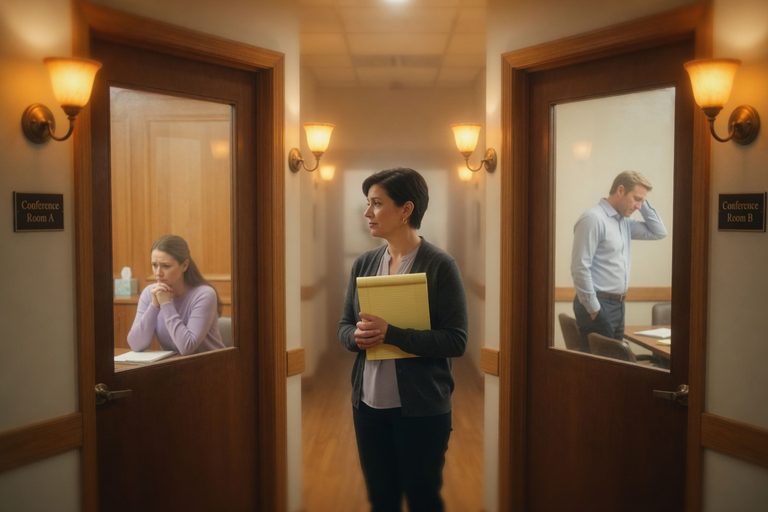
Separate rooms, a mediator walking between you, a written plan the child can live with. For families who cannot share a table.