Putting Children First
When Your Child Comes Home Angry and Needs a Couple of Days to Settle
Learn how to give your child a calm landing after a hard handoff, when a day or two of settling is normal, and when to seek professional help.

Why kids often prefer one parent after a divorce, when it signals something more serious, and how to keep your child out of the middle.
Best for the Children Editorial·8 min read·October 18, 2026
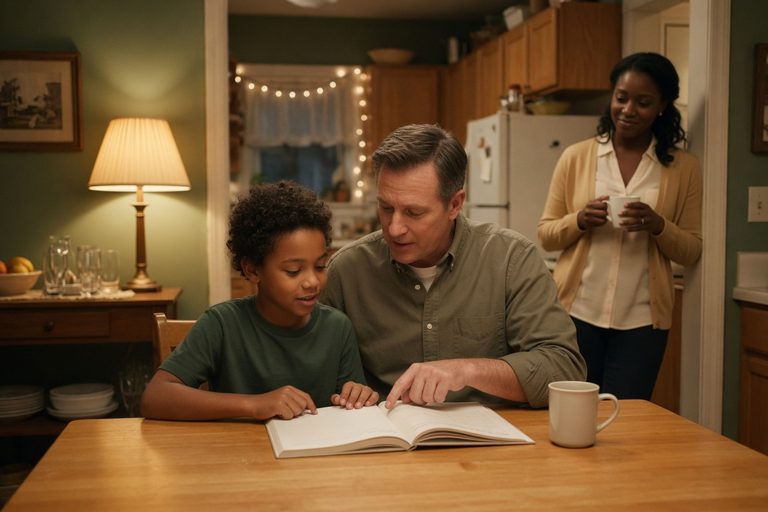
Your child comes back from the other house and talks about nothing but how great it was there. Or you hear "I want Dad," "I want Mom," at bedtime and it hurts. It's normal to wonder whether your child is judging you. Usually they aren't. Plenty of children lean toward one parent for a while after a separation, and the reasons tend to be ordinary ones: where they sleep most nights, who enforces the rules, what feels familiar. Below we cover those everyday reasons, the signs that something more serious is going on, and what you can do now so your child doesn't end up stuck in the middle.
Children's feelings toward their parents tend to come in shades, not as a clean choice between two sides. One study by J. R. Johnston followed 215 children, some from family court cases and some from the general community, for two to three years after their parents separated. Their attitudes toward each parent ran across a range from positive to negative. Relatively few were strongly aligned with one parent or strongly rejecting of the other.
Researchers Joan Kelly and Janet Johnston describe parent-child relationships as a scale that runs from "positive and secure" at one end to "negative and alienated" at the other. Most children sit closer to the secure end with both parents, even if they feel warmer toward one of them on a given week.
A preference also tends to move. The parent your child wants at bedtime this fall may not be the one they want in the spring. A child who clings to one home around a hard handoff, or who's anxious about how the holidays will be split, is often reacting to the change itself and not to who you are.
So the first thing to do is stay calm. The second is to understand what might be behind it.
Most of the reasons are practical.
Much of what parents notice here comes from families living under one roof. Divorce often makes all of it louder.
Sometimes the lean isn't about rules or comfort. It's about a child trying to get out from under the adults' fight.
In one study, more than 500 adolescents were interviewed about four years after their parents separated. Those who felt torn between their parents were more depressed and more likely to have behavior problems than teens who didn't feel that way. The teens named three things that made them feel caught in the middle:
None of these feels big when you do it. "Tell your mother the check is late." "Who was at your dad's this weekend?" A sigh and an eye-roll when the other parent's name comes up. But a child who hears enough of this may stop trying to love both of you and pick the side that makes the noise stop. In our years around family court, these are the things children tell us they hate most.
The same study had good news too. Teens who were close to the parent they lived with, and whose parent knew their friends, activities and whereabouts, did better.
Sometimes a child keeps their distance from a parent for good reason. Researchers call this "realistic" or justified estrangement. It can follow:
In one legal writer's summary, a child's estrangement in these situations is "reasoned, adaptive, self-distancing and protective." The child isn't being manipulated. They're protecting themselves.
This is a different thing from a child being turned against a parent, and the difference matters. If you are the parent your child is pulling away from, ask yourself honestly whether any of the list above fits, even a little, even only on bad days. If you are the favored parent, try not to read your child's distance as proof that the other parent is a bad person. Take it as a reason to look more closely.
A child can also be pushed away from a parent by the other parent's behavior. People call this "parental alienation." The term is contested, and Johnston's research describes the older "parental alienation syndrome" label as controversial.
Behaviors linked to a higher risk include running down the other parent's character, starting a new relationship soon after the separation, and leaving abruptly. Kelly and Johnston have argued that many parents in high-conflict divorces do some of this kind of indoctrinating, yet only a small share of their children become alienated. Most children in hard divorces hold on to both parents.
Alienation is often claimed and less often proven, and estrangement is easy to mistake for it. Recall that Johnston found rejection usually has several causes at once: the favored parent, the rejected parent and the child's own vulnerabilities. If you jump straight to "alienation," you may miss the part you can actually change.
Your child's preference this season isn't the final word on you as a parent. What matters most is whether they can love both of you without paying a price for it.
Photo by Jupilu on Pixabay.
Learn how to give your child a calm landing after a hard handoff, when a day or two of settling is normal, and when to seek professional help.
The first report card of the year can start a blame game between homes. How to share school information, set up homework in two houses, and keep grades from becoming evidence.
Learn what to tell your child when each home has different candy rules, plus shared safety steps and a plan to agree on with your co-parent.