
Putting Children First
When Your Child Wants Both Parents at the Same Holiday Dinner
Thinking about a shared holiday dinner with your co-parent? Learn when it helps kids, the warning signs, how to set it up, and how to say no kindly.
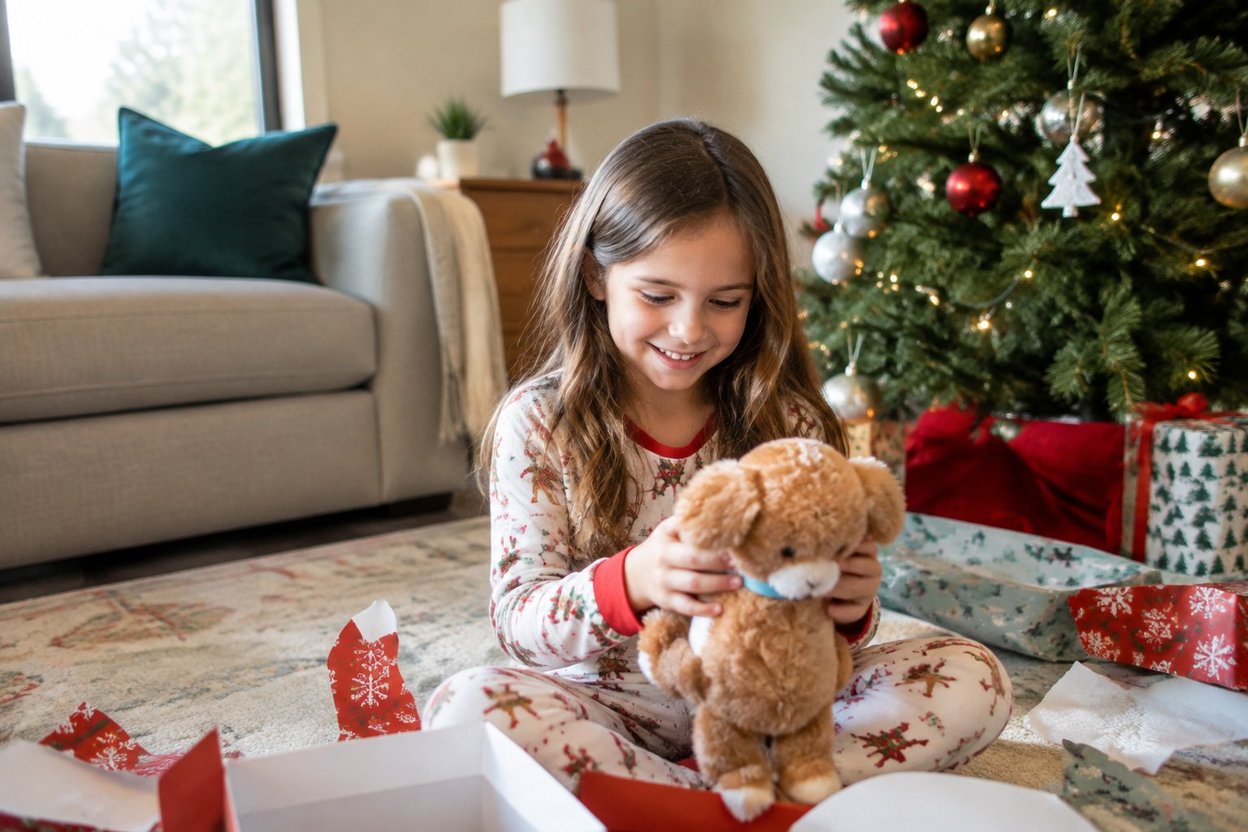
Christmas gifts usually go where your child goes. Learn how to check your order, when a gift can stay home, and how to keep kids out of the middle.
Best for the Children Editorial·9 min read·November 28, 2026
It's Christmas morning and the wrapping paper is still on the floor. Your child holds up the thing they wanted most and asks, "Can I bring this to Dad's?" or "Can I show Mom?" You hesitate. Maybe you paid for it, or maybe you worry it won't come back. In most families the answer is yes. The gift belongs to your child, and unless your court order or a real safety concern says otherwise, it can go where your child goes. Below is where to check your own order, when "this one stays here" is fair, and how to keep your child out of the middle.
In most cases your child can take Christmas presents to the other parent's home. A gift is given to the child, not lent to them for use at one address. We know of no general rule anywhere in the US that lets one parent keep a child's gifts at one house.
Family lawyers tend to say the same thing. A North Carolina family-law firm puts it on its list of holiday "don'ts": "Don't prevent the child from taking your gifts to the child to the other parent's house."
What actually controls your family is your parenting plan or court order, so read it first. Some plans say plainly how belongings move between homes. Many say nothing about it. You can put the order's schedule on one page with our calendar builder, which merges your parenting schedule with your school's calendar.
That gap matters in both directions. If your order doesn't clearly say a child's things must travel or must come back, it is hard to enforce either way. The other parent can't easily make you send a gift along, and you can't easily make them return one. Judges usually want a clear written instruction before they will punish someone for breaking an order. A vague order won't settle a fight over a toy. Most of the time the two of you will have to work it out, and the rest of this article helps you do that.
Think about it from your child's side. They got something they love, and they want to show it to the other parent, play with it at the other house, and bring it to the cousins' on the other side. That isn't disloyalty. Children don't live in two separate lives. They have one life split across two homes.
When a rule says a gift is "only for Mom's" or "stays at Dad's," the child is the one stuck in it. They have to remember the rule, enforce it on themselves, and sometimes explain it to the other parent. Over twenty-five years we've heard what children say about this kind of thing. They notice when their things become part of the grown-ups' disagreement, and they don't like it.
In a 2013 Associated Press story on holiday gifts after divorce, family law attorney Alan Plevy advised against limiting a gift to one house: "Children value peace over presents." A Georgia family-law firm makes a similar point. Children remember experiences and how you made them feel, not necessarily the gifts, and competing over presents doesn't help anyone.
There is a fair counterpoint. Things that travel get lost. In that same AP story, one mother's kids carried an Xbox back and forth, parts and games went missing, and the siblings eventually saved up to buy a second one. A father in the story said that with a smaller home, he preferred not to keep things he had no room to store. Later he saw that having gifts at his house gave the kids something to look forward to there. Space and loss are real problems, and they can be solved without telling the child no.
Get your parenting plan out and read it slowly. You're looking for anything about "personal belongings," "personal property," "clothing and possessions," or what happens "at exchanges."
Some plans say a lot. Idaho's court self-help parenting plan form includes this sample clause: "The parents shall deliver and return each child's personal belongings at the same time they exchange each child. Parents shall assist a child to remember to take the personal belongings and school supplies s/he needs." That is a form, not a law. It only binds you if your plan adopted it, but it shows what clear wording looks like.
Other plans say nothing, and then there is very little to enforce. A South Carolina family law attorney wrote about a case where a parent argued that having custody meant controlling the child's things. The judge rejected that argument. The order said nothing about returning items, and contempt requires commands that are "clear and certain rather than implied." Custody alone didn't create a duty to send things back.
That attorney suggests adding plain language, such as: "The non custodial parent shall return the child's items." OurFamilyWizard's parenting-plan checklist goes further. It suggests a plan should say whether both parents agree to keep a set of the child's belongings at each house, should define which belongings move back and forth and how, and should answer the question "What happens if something is forgotten?"
Family law differs from state to state, and so do judges and local forms. Idaho offers a ready-made clause. In South Carolina, the case above turned on what the order did and didn't say. Your state may handle it differently again. Read your own order, and check your state's court self-help forms if you're writing a new plan.
Most gifts should travel freely, but not every one. Some exceptions are reasonable:
If a gift has to stay at one house, decide that between the two adults before Christmas, not at the door. Then tell your child calmly before the handover, with a simple reason: "The tablet stays here because Dad's house has different screen rules. Your new books and the art set can go." Children handle a clear plan much better than a surprise, especially a surprise that happens while both parents are watching.
Look honestly at your own shopping list, too. FindLaw warns that a gift chosen to upset an ex can backfire: "if your kid brings that gift to the other parent's house, it could cause some consternation and may even get your child in trouble." It suggests that a gift you know is disputed should be agreed to "only stays at your house." Kathryn Dickerson, a family law partner quoted in the AP story, said gifts given without thinking about the other parent can make things worse. If the main point of a present is to make a statement to your ex, your child ends up delivering that statement.
Most gift fights can be headed off weeks ahead, and Thanksgiving is a natural time to settle the plan. Some ideas that work:
If a gift goes to the other home and doesn't return, start with a short, polite written request. Say what the item is and when it should come back. Keep a simple record of what went over and what came back.
A Durham, North Carolina firm suggests telling children who are old enough that you expect them to come home with their things. Then let them help without making them responsible for the adults' dispute. If lost items become a chronic problem, the firm says to raise it with your lawyer.
Before going to court, suggest a mediator. A mediator can help you agree on a clear belongings clause, which may solve the problem for good. In the South Carolina case, the dispute ended with the father agreeing to return the items after each visit. If you're already modifying your plan, ask to add plain wording about belongings. For advice on your specific order and your state's rules, talk with a local family lawyer.
Thinking about a shared holiday dinner with your co-parent? Learn when it helps kids, the warning signs, how to set it up, and how to say no kindly.
Plan holiday family visits around your child's need for breaks, with quiet-space tips, wording for relatives, and how to check your custody order first.
Your child worries about leaving you alone at Christmas? Learn how to reassure them, make your own plan, and let them enjoy the other home.