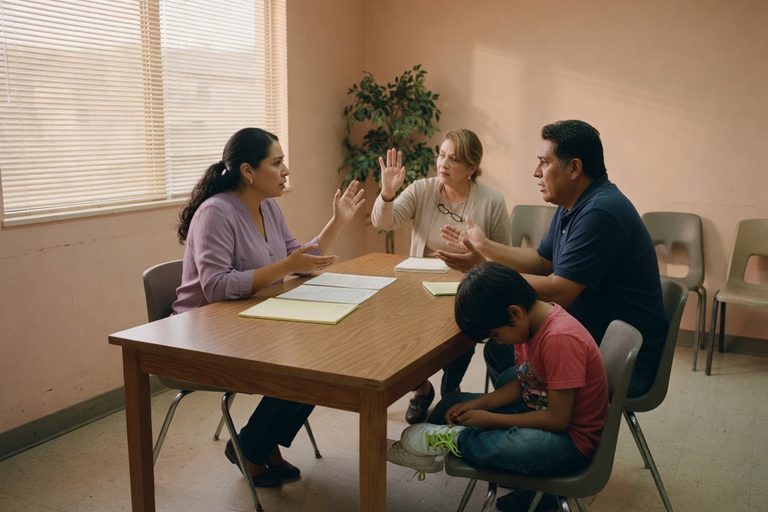
Mediation & Settling Outside Court
Should Your Child Sit In on Mediation?
Should your child sit in on custody mediation? Why the room is built for adults, how a child's voice can be heard safely, and what to tell them afterward.

Settle the child’s week first — school, doctors, bedtime, holidays, how you will talk — before you fight over legal labels.
Best for the Children Editorial·5 min read·September 9, 2026
Parents often walk into mediation ready to argue labels: sole, joint, primary, 50/50. Kids do not live inside those words. They live inside school mornings, a doctor who knows their name, a bedtime that does not change every three days, and holidays that are not a surprise. If you settle the child’s life first, the legal labels get easier. If you fight the labels first, the child’s week stays a mess while the adults score points.
Bring a real calendar, not a theory. School start time, after-school care, practices, medical appointments, and which house is closer to which building. A plan that looks fair on paper and puts a seven-year-old in a car for ninety minutes before math is not a child-first plan.
Write down, in plain language:
Those five items prevent more conflict than a paragraph about “joint legal custody.” How to prepare for mediation covers the room and the papers. This is the substance you should walk in with.
Legal custody is the right to decide big things. Parenting time is when the child is with you. Families blow up when those two are treated as the whole story and nobody writes down the boring middle.
Agree, in the plan, on:
If you cannot agree on a school, say that out loud in mediation instead of hiding it under “joint decision-making.” A mediator can help you design a tie-breaker. A vague sentence will send you back to court the first time kindergarten registration opens.
“We’ll work it out” is how December becomes a hostage situation. Put years in writing: even years / odd years, or a fixed rotation, plus pickup times. Name the holidays your family actually celebrates. If one of you is military or lives far away, build travel time into the block instead of pretending a Friday 6 p.m. exchange still works. See holiday schedules that work for kids in two homes and summer parenting time.
Right of first refusal sounds child-friendly until it becomes a weapon. Some families need it. Some should leave it out. Right of first refusal is a separate decision, not a default.
A parenting plan that assumes warm teamwork will fail the first ugly week. Write the communication rules while a mediator is in the room:
If sitting in the same room is unsafe or useless, ask about shuttle mediation before you quit on settlement. You do not have to share a table to write a plan a child can live with.
Tired people sign bad plans. Watch for:
You can settle without a trial. That is the point of mediation versus court. Settling is not the same as giving the child a week they cannot survive. If the draft only works on a whiteboard, it is not ready to sign.
Do not hand a nine-year-old the legal document. Tell them, together if you can, or in matching words if you cannot: which days they are where, who picks them up, and that the plan is the adults’ job. How to talk with kids about two homes is the script. If they stall at the door later, that is a transition problem, not proof the whole plan is void.
This is educational information, not legal advice. What a mediator can do, and what a court will sign, depends on your state and your facts. Talk to a licensed attorney where you live before you sign anything.
This site is not a law firm. A mediator is not your lawyer. Read the draft, sleep on it, and have someone licensed in your state look at it before you sign.
Should your child sit in on custody mediation? Why the room is built for adults, how a child's voice can be heard safely, and what to tell them afterward.
Sometimes both parents show up, talk for hours, and still walk out without a signed plan. That is not a personal failure and it is not a signal to put the
Separate rooms, a mediator walking between you, a written plan the child can live with. For families who cannot share a table.